Discover Historic Williamstown! Week 7

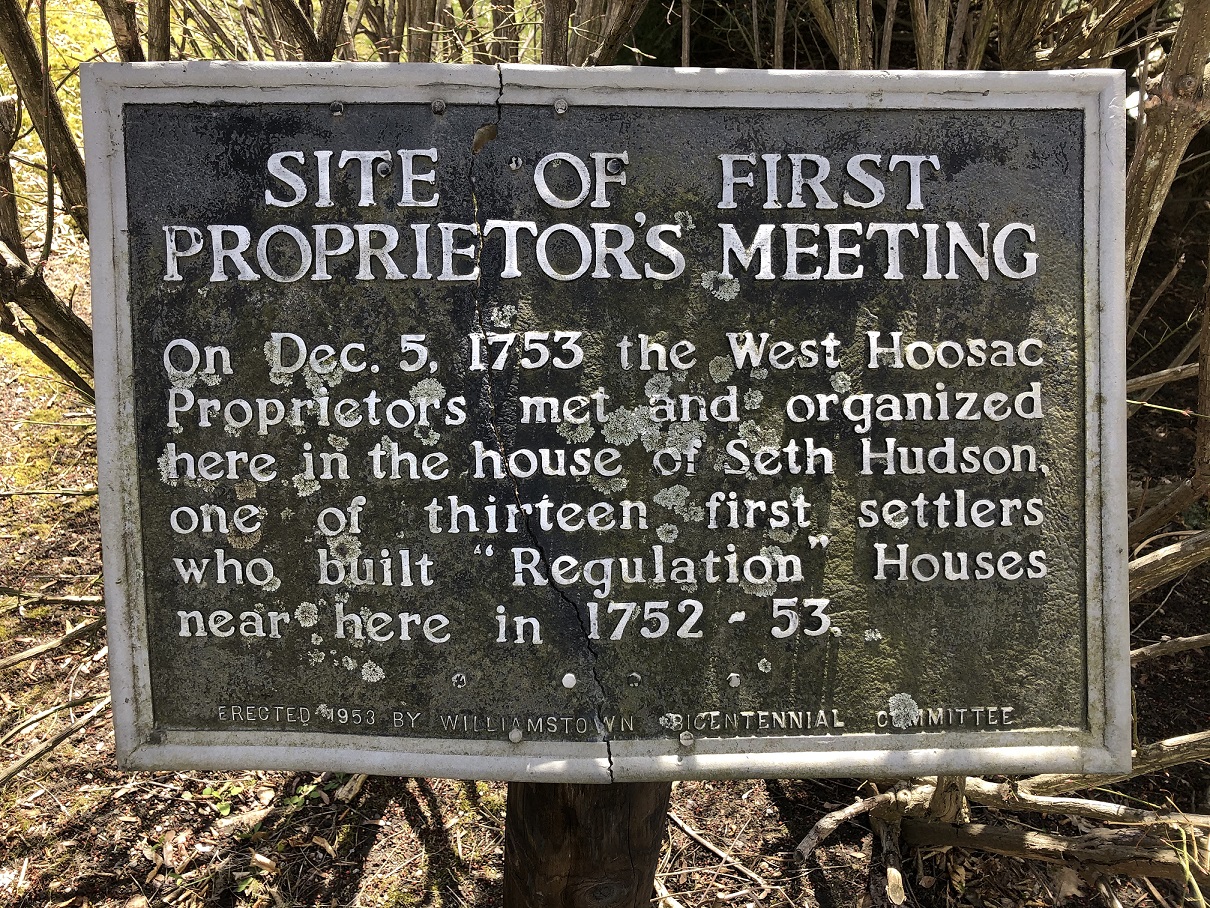
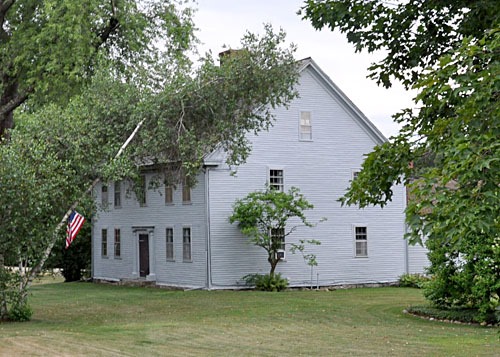
We hope you have had a good week and that you were able to find last week’s historic site, located on the western end of Main Street, the site of the first proprietor’s meeting.  Our next historical marker is located at River Bend Farm or Simonds’ Tavern. Built in 1770 by Benjamin Simonds (1725/6-1807), the house was listed on the National Register of Historic Places in 1983. Can you locate this marker? (Hint: It is NOT at the location of Simonds’ first home, pictured here.)

Benjamin Simonds

Benjamin Simonds had amassed quite a bit of property in Williamstown when, in 1769-1770, he built River Bend Tavern in the White Oaks neighborhood, a mile north of The Square (Field Park). Years earlier, in 1746, Simonds and his fellow captives from Fort Massachusetts rested at this location on the banks of the Hoosic River on their first day’s march to Canada.

The rivers were the highways of that period, the fastest and most direct route over which to transport people and goods. While the Housatonic and the Connecticut Rivers flowed southward to Long Island Sound, the Hoosic flowed northwards to the Hudson and thence to New York City.

The Hoosic is a three-state river, fed by streams that run down from the Green Mountains of Vermont, the Taconic and Hoosac Ranges, and the Mount Greylock Massif. It runs 70 miles from where it begins, at the man-made Cheshire Reservoir, to where it enters the Hudson river at Stillwater, NY. Altogether, the Hoosic and its tributaries – the Green River, the Little Hoosic, the Walloomsac, the Owl Kill and the Tomhannock – drain 720 square miles of land.

(For more information on the Hoosic River please visit HooRWA – the Hoosic River Watershed Association – at https://hoorwa.org. This map of the watershed is available from them.)

The Hoosac Mountain Range divided the Deerfield (and hence the Connecticut) and the Hoosic (and hence the Hudson) watersheds, nevertheless the Hoosic created an important in link between Boston and Albany, and via the Mohawk River to the Great Lakes region and the American west.

In the 18th century the Dutch owned the land along the Hudson, and the French were moving down the Champlain Valley from Canada, so the British moved in from the east. Thus, the Hoosic watershed became a battlefield for three European powers and their Native American allies. The British finally drove the French north after skirmishes on lakes Champlain and George, and also at Fort Massachusetts.

The settlement that became North Adams, at the confluence of the north and south branches of the Hoosic, and the one that became Williamstown, at the confluence of the Green and Hoosic Rivers, were key sites along an important trade route; one that was only enhanced by the construction of the Champlain Canal (completed in 1823), the Erie Canal (1825) and the Hoosac Tunnel (1873).

Simonds’ River Bend Tavern was located at the intersection of two important trade routes, the Hoosic River itself and the north/south roadway linking the Housatonic, the Hoosic, and the Walloomsac in Bennington, now US Route 7.

At the time Benjamin Simonds built his River Bend Tavern in the White Oaks section of Williamstown, there were at least three other taverns operating here, all but one at the confluence of important waterways. All or some portion of three of those four taverns are still standing today.

As you read the following paragraph, it is important to remember that colonial taverns were only accessible to white men.

Taverns were important outlets for gathering information in an age before the wide distribution of newspapers and tavern keepers were often trusted informants and confidants as well as fountains of information about the political and social turmoil of the time. Despite efforts by Puritan reformers to close taverns to reduce public drunkness and prevent anarchy, almost all politicians found it necessary to visit them if they wanted any real contact with the public.

In South Williamstown, Samuel Sloan’s tavern sat at the confluence of the east and west branches of the Green River and at the crossroads of the north/south roadway that is now US Route 7 and the roads east to Troy, NY, and other Hudson River port cities.

Site of former Sloan Tavern

Nehemiah Smedley’s tavern sat close to the confluence of the Green and Hoosic Rivers, on the Mohawk Trail, a centuries old east/west trade route.


Smedley Tavern

Josiah Horsford’s tavern, the only one not still standing, sat in the center of Williamstown, on the northeast corner of the junction of Main and North Streets (now Routes 2 & 7), where the Greylock Quad now sits. At that time Main Street continued west over the Taconic Range to Petersburgh NY and on to Troy. This tavern was kitty-corner to the meeting house which was the seat of town government at that time.

Views of River Bend Farm (Simonds Tavern) over the years. The 1876 map shows the farm under the ownership of J. L. Cole, who sold the property shortly thereafter, disillusioned by the incursion of the railroad and opening of the gravel bed. The large number of different Cole families owning property along what is now US Route 7 (Simonds Road) lent the area the name Coleville.

The original farm covered 170 acres along the banks of the Hoosic River and Broad Brook, but over the centuries land was sold off and farm outbuildings were destroyed. (Note the barns and silo behind the home in one shot.) The property was operated as a dairy farm well into the 20th century. The central chimney draws from five fireplaces.

One of Williamstown’s best pieces of farm land, River Bend Farm has had many owners since white settlers came to this region.

From The North Adams Transcript, December 27, 1939
by William B. Browne

[The northwest corner of Williamstown] was identified with the Smedley family for a long time and Ephraim Seelye, second of that name, bought up many of the oak and pine lots…

Seelye also owned…River Bend Farm having bought it in 1766 and in 1769 sold it to his son-in-law Elihu Ketchum. In the same year it was sold to Col. Benjamin Simonds. It seems probable that about 1770 Simonds commenced building the splendid house we now see on this farm. In 1813 the farm was sold by [Simonds’ son-in-law] Benjamin Skinner who said in his deed that Simonds had sold it to his brother, Tomson (sic) Skinner, in 1802 whose administrators had conveyed it to him in 1818, but neither deed is on record.

…In 1813 [Benjamin] Skinner sold River Bend Farm to Asa Northam who in 1836 sold it to Asa Northam, Jr. In 1836 it was owned by Leonard Cole and afterward by John C. Cole.

From the Pittsfield Sun, March 12, 1868:

John L. Cole [and his wife Ferry] purchased the “River Bend Farm” for many years owned by his father, the late L. W. Cole, paying therefor the sum of $9,000

From other sources:

John L. Cole sold the farm to George H. Prindle in 1877 who advertised the property for sale in 1919 & 1924, but in 1938 the farm was owned by Eugene P. Prindle, undoubtedly a relative.

It is not clear when Mr. & Mrs. Oliver Nichols acquired the property, but in 1950 they bought the Henderson Road home of Kenneth G. and Edith C. Ware and the Wares bought River Bend Farm, which they, and subsequently their son David F. Ware, operated as the Sunrise Dairy Farm.

In 1977 David J. and Judith A. Loomis bought River Bend Farm, which they operate as a bed & breakfast. They have owned the property longer than any other owners of record.

There are two reasons why River Bend Farm is such a showplace of 18th century architecture today. The first, oddly enough, is that many of the owners over the years were not very wealthy people. For much of its history it was a working farm and the people who owned it were farming families.

While these owners were proud of their home, when they went to spruce up or modernize, they tended to layer the new over the old, rather than tearing the old materials out and replacing them.

Which brings us to reason numbrr two: Dave and Judy Loomis. Since they bought the property in 1977 they have worked tirelessly to restore the original look of the house, while bringing the heating, electrical, and plumbing systems up to 21st century code and standards in order to operate it as a bed and breakfast. (Good news! As of – June 8, 2020 – River Bend Farm is once again open for business!)  http://www.riverbendfarmbb.com/about.html

“We did the restoration a room at a time and we could almost feel and hear the energy of each space as we uncovered the older construction,” Dave Loomis explained.

The parlor, the formal room downstairs, had a strange configuration of panels on the wall, and Judy was dying to find out what was under the sheetrock so she cut a little hole and from what we saw we were able to deduce that the whole wall was paneled! That gave us the direction in which to work and explained why the room was the way it was.”

Photo courtesy of David and Judy Loomis

The other downstairs room is the tap room where Benjamin Simonds kept his tavern. There was no bar as we know it today, but the room was a gathering place.

There were two entrances to the tap room, Dave Loomis explained, the front door with the pillars, and the “funeral door” on the south side of the building. “Many times wakes were held in taverns in those days, and so they needed an entrance wide enough and straight enough to maneuver a coffin in and out for the viewing. It was considered pretentious for common folk to enter through the front door, and all the physical evidence indicates the funeral door had much more use over the years.”

After the covered bridge over the Hoosic, known as the Moody Bridge, was replaced with an iron span in the 1930’s and a poured concrete structure in the 1990’s, the front yard of River Bend Farm took on a very different aspect from its original. “The house used to sit on a promontory and you looked up at it from the road (Simonds Road/US Rt. 7),” Loomis said. “Now it is lower than the roadbed, with the result that that side porch by the funeral door is no longer a pleasant place to sit.”

There are now four bedrooms upstairs (see photos), but originally there were just two front bedrooms and then a great room in back, serviced by a small back staircase. “The front rooms have plaster walls and chair rails, but the big room at the back plank walls and fewer windows, and plank rather than panel doors,” Dave Loomis explained. “There is only one fireplace upstairs in what was probably the master bedroom. I guess Benjamin Simonds liked to be warm!”

The attic is wide open and also contains a baking oven. There is evidence that someone lived up there over the centuries, maybe farmhands or maybe children of the large farm families craving a little personal space.

The basement, which has a dirt floor and a field stone foundation, contains two large bake ovens and a big , very similar to those recently restored at the Smedley house (see photo), which was built at much the same time period. “Probably these big ovens were used by people throughout the neighborhood who brought their loaves to the farm on baking days.”

There is also evidence of a big water cistern in the basement, although the original well was across the road at what is called the Hawkins House, at the intersection of Simonds Road (US Route 7) and North Hoosac Road, where Benjamin Simonds died. Dave recalled that the well was filled in because it was considered a danger to neighborhood children.

“From one preserved window shutter we were able to copy the pattern and hardware,” Dave added. “Most of the ironwork is probably civil war era and our local blacksmith, Bill Senseney, recreated the door hinges and latches.”

Three sides of the house are original clapboards with the hand forged nails still in there and still doing their job. In 1896 the North Adams Transcript recounted when J. L. Cole, who had been born at the farm, traveled from Seattle for a visit. “Mr. Cole pulled one of [the hand wrought nails] out of the house and had it attached to his watch chain as a charm…He will also take home a few shingles from the covering over the cellar-way, which were there when his father bought the farm, the spinning wheel his mother once used, and an old wooden coat hook which he found in the garret.”

Have you been able to find this historic site and the its marker, located at 643 Simonds Road ?  We hope you will photograph it and send the image to info@williamstownhistoricalmuseum.org.  Learn more about the other historic sites featured in this series here:  
https://www.williamstownhistoricalmuseum.org/programs-events/explore-historic-williamstown-historic-site-marker-scavenger-hunt/ 
Discover Historic Williamstown Week 6


We bet this week’s historical marker will be puzzling to folks for many reasons. Where was Seth Hudson’s house? Who was Seth Hudson? Who were our first settlers? Who were the West Hoosac Proprietors?

And, most importantly, what is/was a Proprietor?

Here’s what Roy Hidemichi Akagi said in The Town Proprietors of the New England Colonies (1924, University of Pennsylvania Press) which is still the authoritative work on this topic.

“[In 1753] the majority of land grants from the General Court of the Massachusetts Bay Colony were made to groups or communities for the purpose of the formation of new plantations and townships. The grantees of these township and plantation grants became known as the proprietors.

These grants gave to the proprietors both necessary ownership and local government powers. This meant that the next stage in the evolution of title was grants from the town proprietors.

Originally, there was no difference between the town and the proprietors, so that a grant from the town was a grant from the proprietors. But as the towns grew and persons who were not among the original grantees of the township came to live in the town, a difference arose between those having the right to vote as to town administration and business affairs and those who had ownership rights in the town lands.

Gradually a separation occurred and the proprietors claimed the exclusive right to convey the land belonging to the original grantees. With their organization as an independent body, they rather than the town members, exercised jurisdiction over the common and undivided lands in any township.”

If you are interested to read further, Akagi’s book is available as a free, downloadable PDF here:The Town Proprietors of the New England Colonies

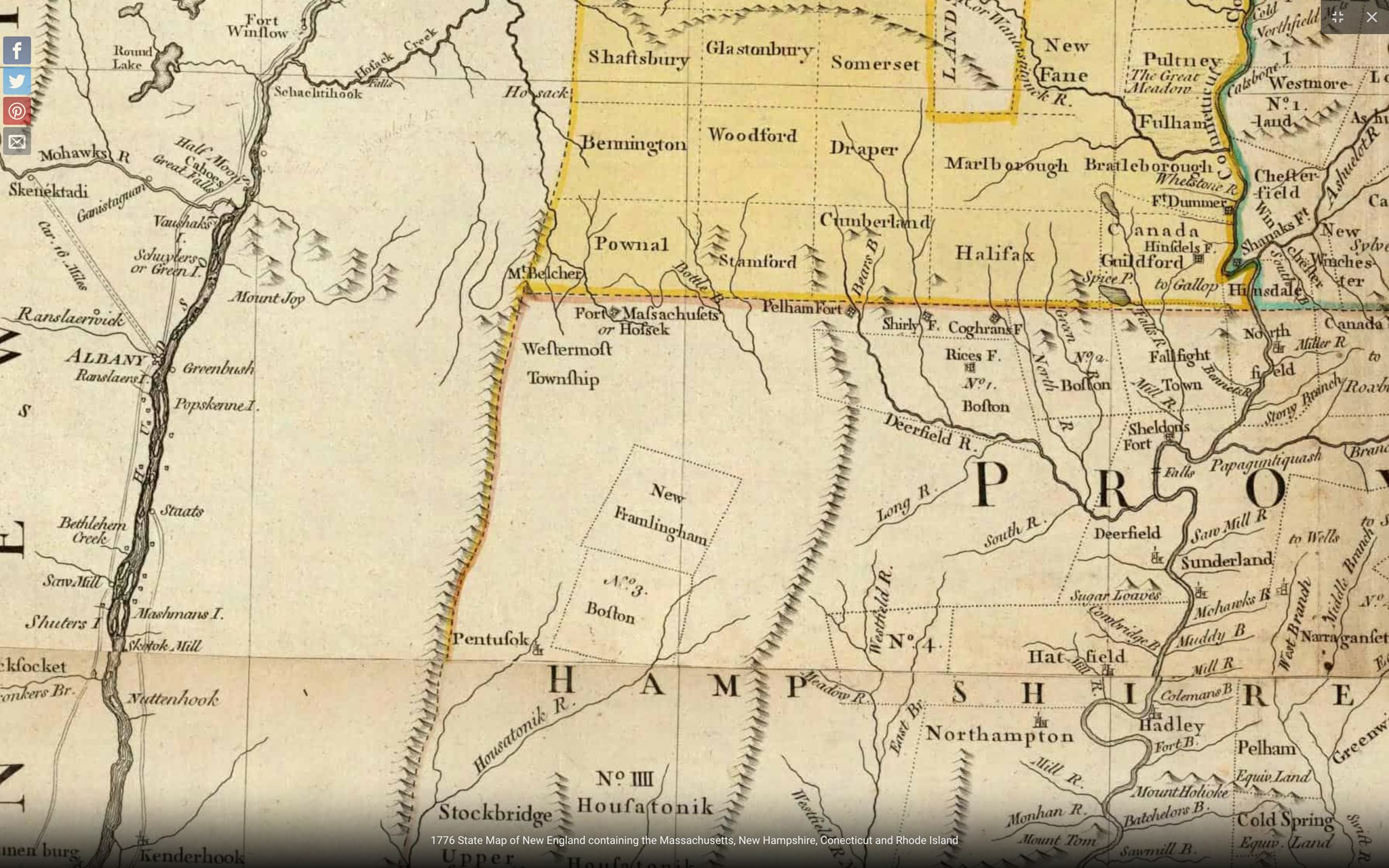
A close up from the 1776 map of our region in Jeffrey’s “The American Atlas: Or, A Geographical Description Of The Whole Continent Of America.”

Who were the West Hoosuck/Hoosac proprietors?

According to Arthur Latham Perry in “Williamstown and Williams College,” 1899″

“…on the 10th of September, 1753, the House of Representatives at Boston voted that William Williams [of Pittsfield, first cousin once removed of Ephraim Williams], “one of his Majesty’s justices of the peace for the County of Hampshire [it was eight years later when Berkshire County was set off], issue his warrant for calling a meeting of the proprietors of the west township of Hoosac so-called…

This vote was concurred in by Governor [William] Shirley and the Council the same day ; and on November 15, 1753, [Williams] issued his warrant to Isaac Wyman of West Hoosac, requiring him “to notify and warn the proprietors of said township that they assemble at the house of Mr. Seth Hudson in said township on Wednesday, the fifth day of December next at nine of the clock in the forenoon to act”…

Such meeting was accordingly holden at that time and place, and inaugurated a successful local self-government, which continued for twelve years the sole authority within “the west township of Hoosac.”

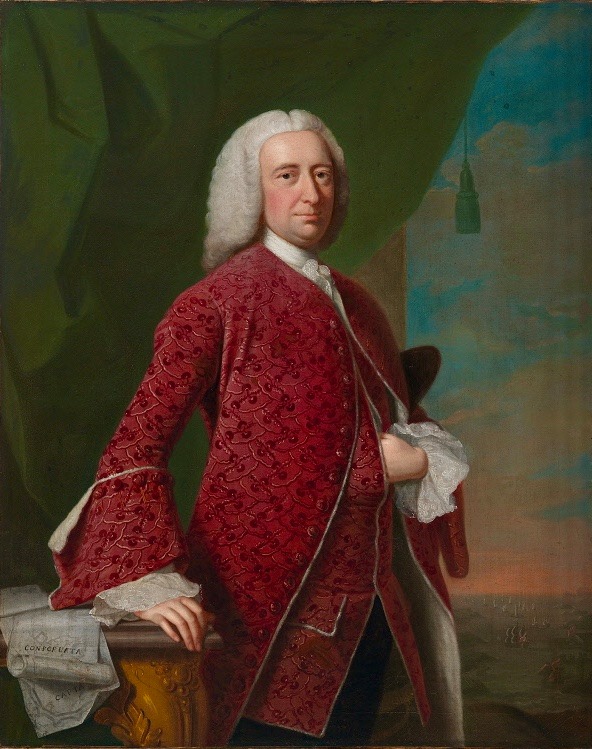
Portrait of William Shirley (1694-1771),
colonial governor of the Province of Massachusetts Bay
by Thomas Hudson, 1750, from the National Portrait Gallery

The proprietors mentioned by name in the record of their first meeting…are : Allen Curtis, Seth Hudson, Isaac Wyman, Jonathan Meacham, Ezekiel Foster, Jabez Warren, Samuel Taylor, Gideon Warren, Thomas Train, Josiah Dean, Ebenezer Graves, — eleven [white] men.

With the exception of Allen Curtis, who was the moderator of the meeting, and who not very long after returned to his former prominent position as a citizen in Canaan, Connecticut, all these had been soldiers in Fort Massachusetts before and all took military service in some form when the French War broke out again in 1754.”


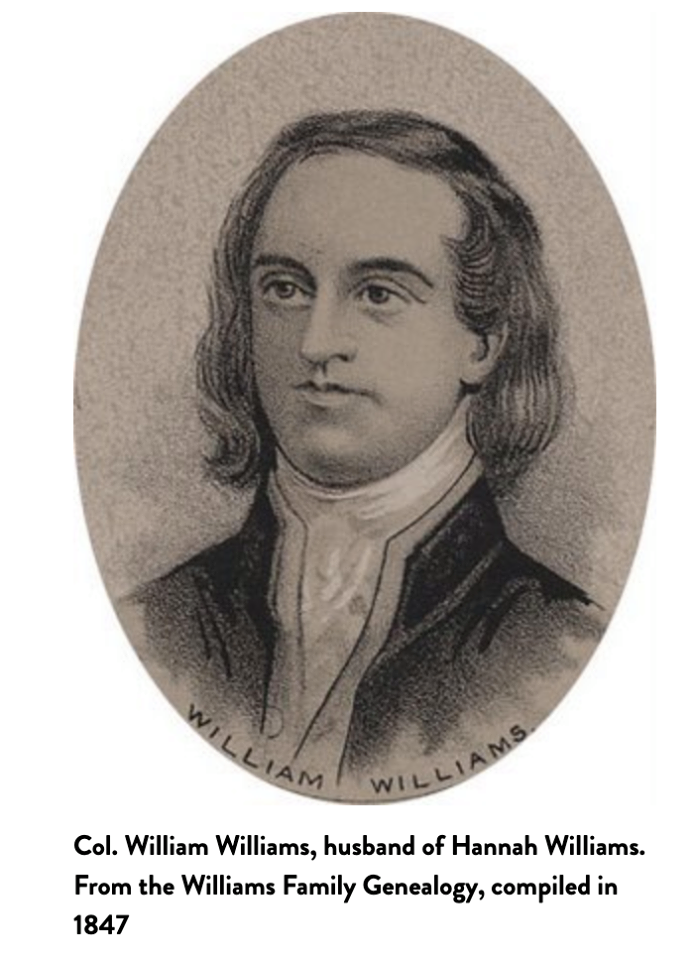
Etching of Colonel William Williams (1710-1785)

Thanks to Patricia Leach and The Clark​ Art Institute for this glimpse of the West Hoosuck Proprietors’ Book and a surveyor’s chain.

“The organization of a village and government had been approved on September 10, 1753, and a meeting of the proprietors was called to ‘determine upon a division of land or part of the lands in said township.’

Over the course of years to come, lands were divided many times and in a number of ways. About a quarter of the first lots were offered to soldiers from Fort Massachusetts in lieu of pay in cash, while many others were sold via lottery in the eastern part of the bay colony. Some of the other first lots were sold to settlers from Canaan, Wethersfield, and New London, Connecticut.

Further divisions of lands were devised to equitably allot the natural resources of the township so that each of the proprietors received a share of fresh meadowland, prime agricultural land, other agricultural lands, pine woodlot, oak woodlot, and forested land on steep slopes.

Lots were measured using a surveyor’s chain, and the measurements were recorded in this book.”

Audio File of Pat Leach’s excerpt on the surveyor’s chain.

You can learn more about the exhibit that included the surveyor’s chain here:
Clark Art Sensing Place Exhibit

Let’s meet the eleven white men who were the Proprietors of West Hoosuck at the first meeting in December, 1753. In 1753 the Massachusetts Bay Colony would only allow white men to own land in its boundaries.

ALLEN CURTIS, the moderator of the meeting, was the only Proprietor not to have been a solider at Fort Massachusetts. He was born on May 18, 1708 in Wethersfield, CT and died in 1783 in Canaan, CT. He hosted the second Proprietors meeting at his home, which stood directly across Hemlock Brook from Seth Hudson’s house.

“Captain Curtis brought his military title from Connecticut, and after a couple of years carried it back there, where he honored it by a life of usefulness.” – Arthur Latham Perry, “Origins in Williamstown,” 1894.

“The infighting between the settlers of West Hoosuck…and the powers in Fort Massachusetts continued unabated…The continuing friction was most evident between natives of Connecticut, who were in the ascendancy in West Hoosuck, and the ‘Bay’ natives at Fort Massachusetts.” – Michael D. Coe, “The Line of Forts,” 2006 (See illustration of the line of forts.)

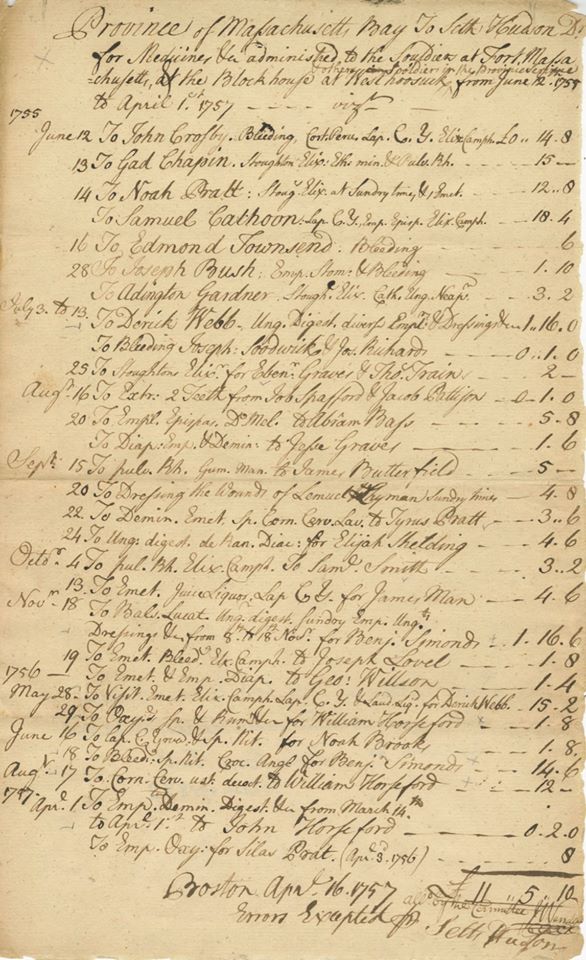
SETH HUDSON treated soldiers at both Fort Massachusetts and Fort Hoosuck. A bill for his medical services survives and is pictured here. He was very influential in the settlement of our town and the last survivor of the original proprietors. In 1756, upon the death of William Chidester, Hudson became the commander of the fort at West Hoosuck.

ISAAC WYMAN, the clerk of that first Proprietors meeting, was the second in command at Fort Massachusetts, having been appointed by Ephraim Williams, Jr.. Born January 18, 1725 in Woburn, MA and died March 31, 1792 in Keene, NH, he married Sarah Wells in 1754 in Deerfield, MA, where the first of their ten children was born. The second was born here in “Hoosuck, Massachusetts” and remaining eight were born in Keene.

“…during the decade of the 1750’s…rancor grew between Williams loyalists like Captain Isaac Wyman and an anti-Williams group led by Seth Hudson.” – Coe “The Line of Forts” 2006

“Wyman…commenced [building] pretty soon on his lot, No. 2, which stretched along flanking North Street on the west side, and the front of which is now graced by the lodge of Kappa Alpha.” – Perry, Origins in Williamstown, 1894

“After 1759 [Wyman] continued to farm the ten acres surrounding Fort Massachusetts (acreage tat had originally been set aside for the use of the fort), but on November 13, 1761, he sold all his West Hoosuck property and moved to Keene.” – Coe “The Line of Forts” 2006

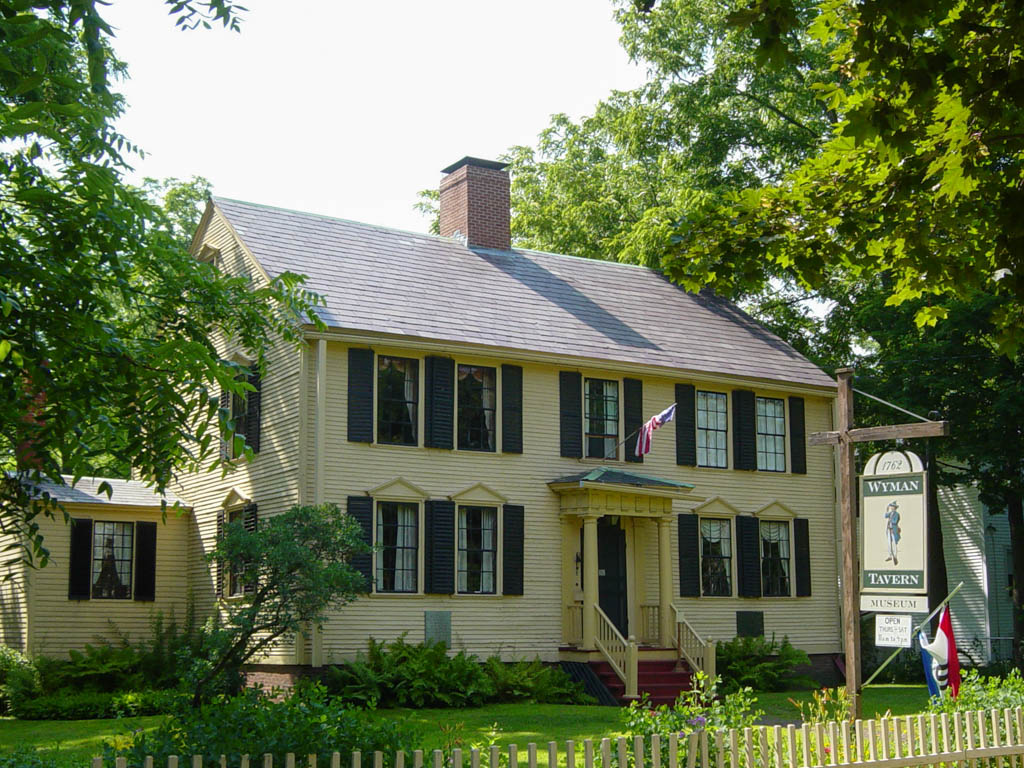
In 1762 Wyman opened a tavern on Main Street in Keene, which is now a museum (see photo). In 1770, the tavern was the gathering place for the first meeting of Dartmouth College’s Trustees. Although advanced in years, Wyman marched at the head of his company to Lexington in 1775, and later served in the Battle of Bunker Hill.

In “Origins in Williamstown (1894) Arthur Latham Perry wrote:” EZEKIEL FOSTER was from Fall Town, now Bernardston and quite constantly a sentinel in the line of forts from the beginning to the end. He drew house lot no. 13 in the original ‘lotting’ of West Hoosac…he was one of the first ‘eleaven families of us,’ already domiciled at West Hoosac, who petitioned Governor Shirley from Fort Massachusetts to which these families ‘ran for shelter upon the late alarm’ in October, 1754, for aid and military encouragement to ‘return to our settlements at the west town.’ Foster became a considerable landowner and a prominent citizen of Williamstown…”

Foster sold Lot No. 13 to Allen Curtis, another original Proprietor, but he “…continued a settler and citizen for many years. but bought lands, and had a home in different parts of town.”

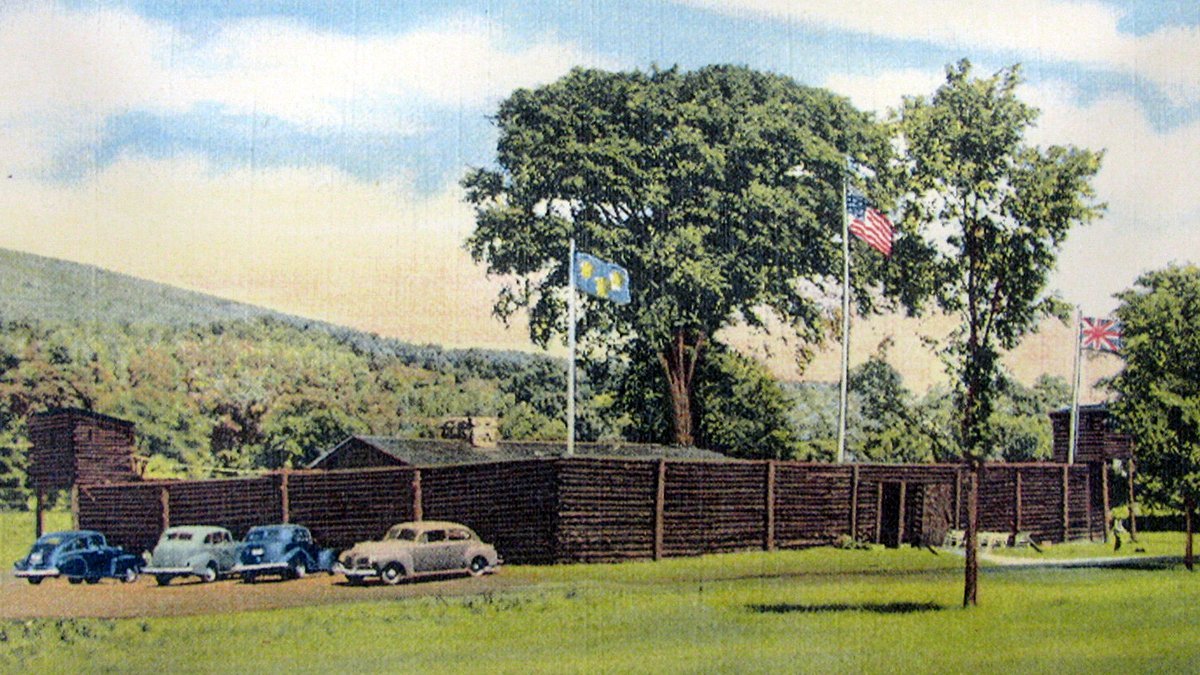
Thanks to Paul W. Marino for a comprehensive, illustrated look at Fort Massachusetts.  Fort Massachusetts by Paul Marino


Postcard depicting 1930’s reconstruction of Fort Massachusetts.

JABEZ and GIDEON WARREN came from Connecticut via Brimfield, MA, and ended their lives in Vermont. Jabez was Gideon’s father, and another son, Jabez, Jr. also moved here, which adds to some confusion since our early records are incomplete.

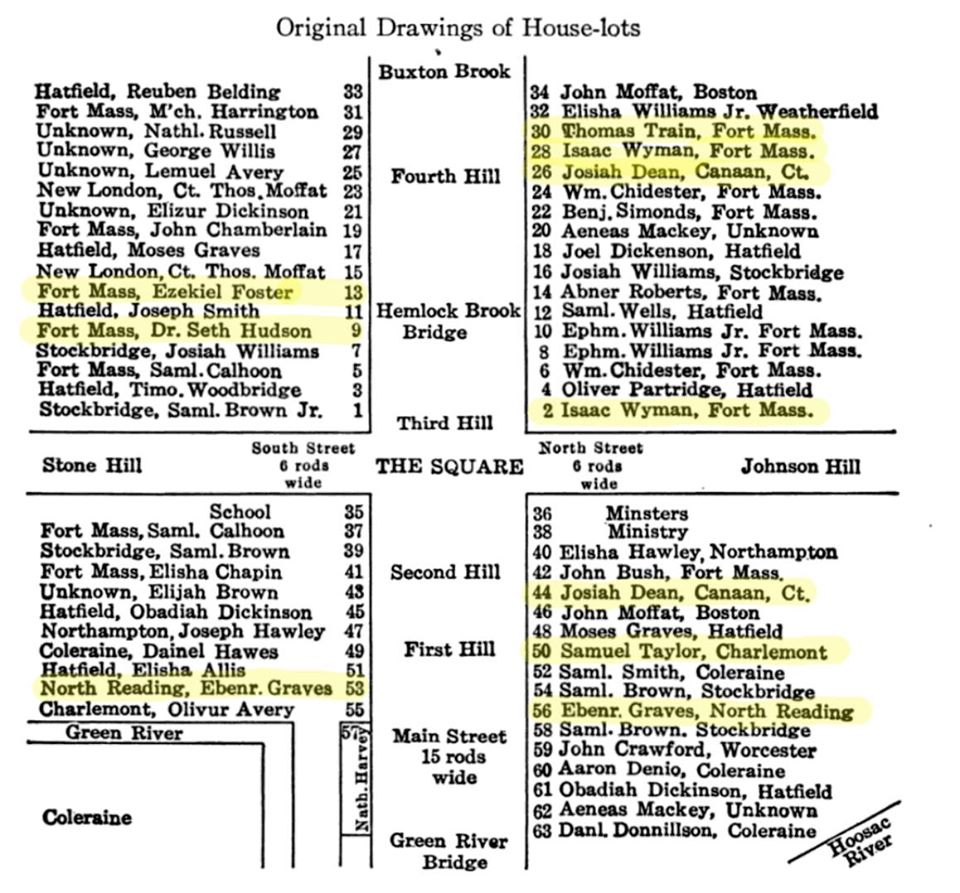
West Hoosac House-Lots with Proprietors’ names highlighted. From “The Hoosac Valley: Its Legends and Its History” by Grace Greylock Niles, 1912

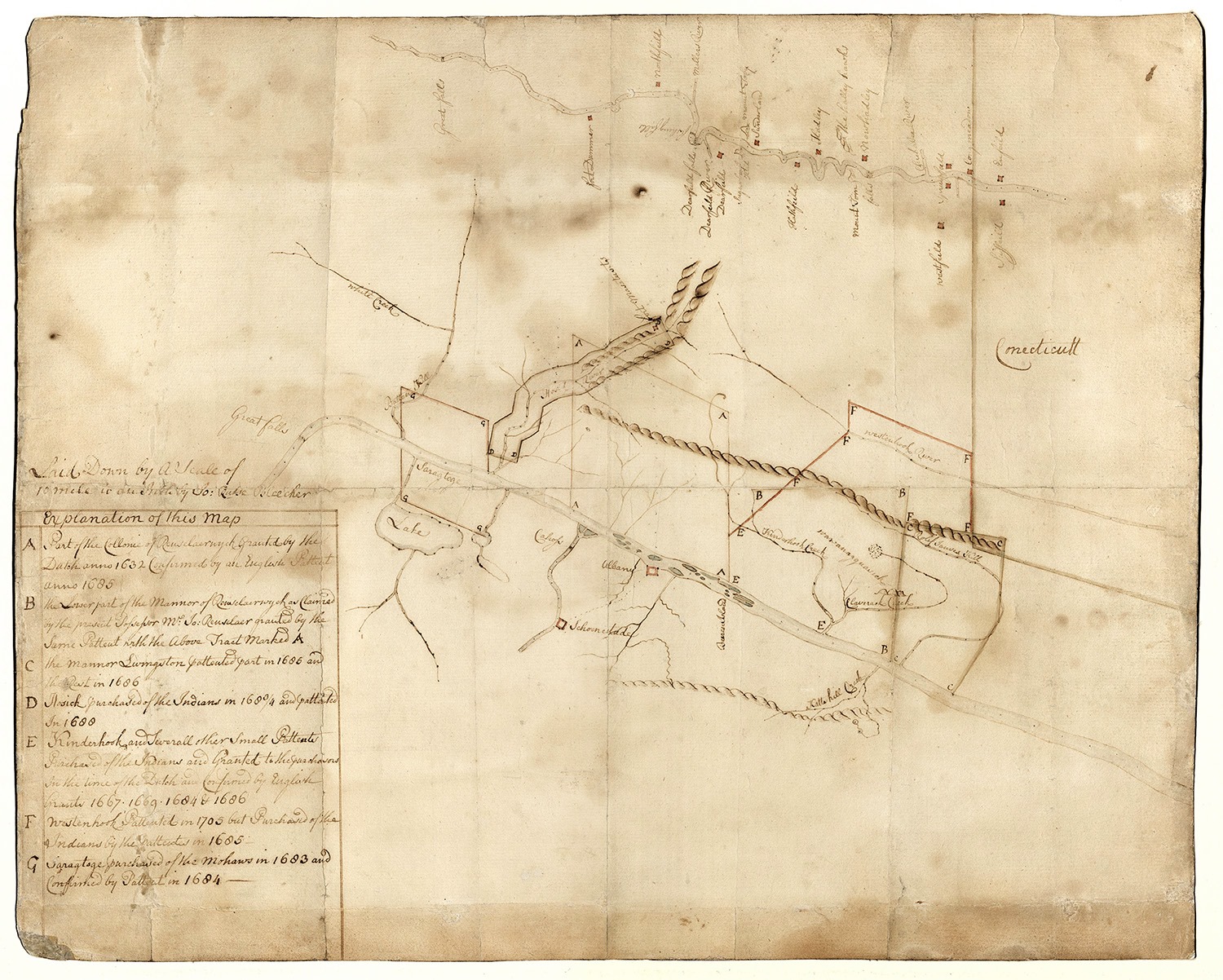
Manuscript map by Albany surveyor John Rutse Bleecker, showing Fort Massachusetts and the Hoosick circa 1745-55, around the time Williamstown (West Hoosac) was settled. Chapin Library collection.

 Here we meet some of our founding mothers for the first time, and encounter names – Blair, Meacham, and Simonds – which remain on our maps today.

JOSIAH DEAN was among the first European settlers to be granted land in what is now Hancock, and he may be the same man of that name to buy at auction in Boston the land that became the towns of Lenox and Richmond for £2,550.

His most significant action in West Hoosuck (Williamstown) was selling Lot 44 to Daniel and William Horsford of Canaan, CT, for “£260 Connecticut money old tenor.” That is the lot on which the Williams College Presidents’ house now sits. William and Esther Smedley Horsford became the second white couple to start a family in town.

JONATHAN MEACHAM, originally from New Salem, MA, bought house lot No. 43 from Seth Hudson for £5, and built his home very close to where West College now stands. Meacham most likely encountered the same problems finding water that the college did, and so he moved to lot No. 49, close to what was called the “college spring.” Later he went to farm on Bee Hill, where many generations of the Hickox family later lived.

Meacham and his wife, Thankful Rugg, were original members of the church, but in February of 1779 a committee was formed “to wait upon Jonathan Meacham to enquire the reason of his absenting himself from communion.” The Meachams were not dismissed from the church, but “are designated among those ‘removed to distant parts.'” While his cousin, James Meacham, “left a large posterity which has continued to be identified with the town…Jonathan left none.”

Jonathan Meacham was with Ephraim Williams at the Battle of Lake George in 1755.

THOMAS TRAIN, born August 1727, was originally from Weston, MA. After an engagement went awry, Train enlisted and came to serve at Fort Massachusetts, where he drew house lot No. 30 in West Hoosuck, close by Benjamin Simonds and his family.

Although he was twenty-four years her senior, Train married 19-year-old Rachel Simonds, daughter of Benjamin and Mary Davis Simonds, the first child born to a European settler in town. They set up housekeeping on the southern slope of Townsend Hill (lot No. 63) where their daughter Sarah “Sally” Train was born in October 1772, exactly nine months after her parents’ wedding.

Before Sally was born Thomas Train had gone off to Virginia and acquired “a good title to some lands.” But on his return journey north he apparently died “and lies buried no one knows where.”

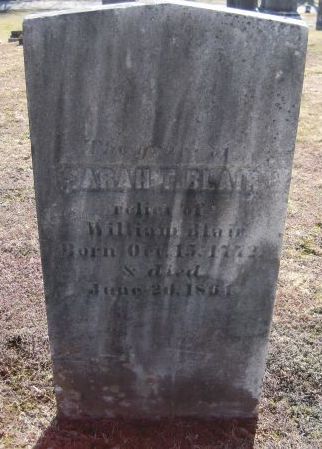
After two or three years of widowhood Rachel married Benjamin Skinner and Sally was raised with the children of that marriage. In July 1792 Sally married William Blair and died in 1864, at the age of 91 “universally respected and beloved.” Her tombstone in Westlawn Cemetery is pictured. Her husband, her son James, her mother, and many other family members are also buried in town.

The museum collection contains a linen sheet from the Blair farm. The flax to make the sheet was grown, processed, and woven in Williamstown by Maria Blair who was the daughter of Sally and William Blair.

Born in 1716 in Northfield, MA, Sergeant SAMUEL TAYLOR served at both Fort Massachusetts and West Hoosuck Fort, where he was the first commander, continuously from 1746-1757. His wife was with him much of the time and their daughter Susanna was born in Fort Massachusetts in 1754, and their son, Elias, in West Hoosuck Fort two years later. Elias Taylor was the first white male baby born in this community.

The year after Elias was born Seth Hudson recounts that Taylor was ordered by Isaac Wyatt to forcibly remove Jabez Warren and his family from rooms William Chidester had agreed they could occupy in his home. According to Hudson’s account, Taylor “…Halled out man, woman & Children Stole their Cloaths & broke to bitts & Destroyed some of Mr. Chidester’s goods…”Not surprisingly, Taylor moved his family out of town shortly thereafter.

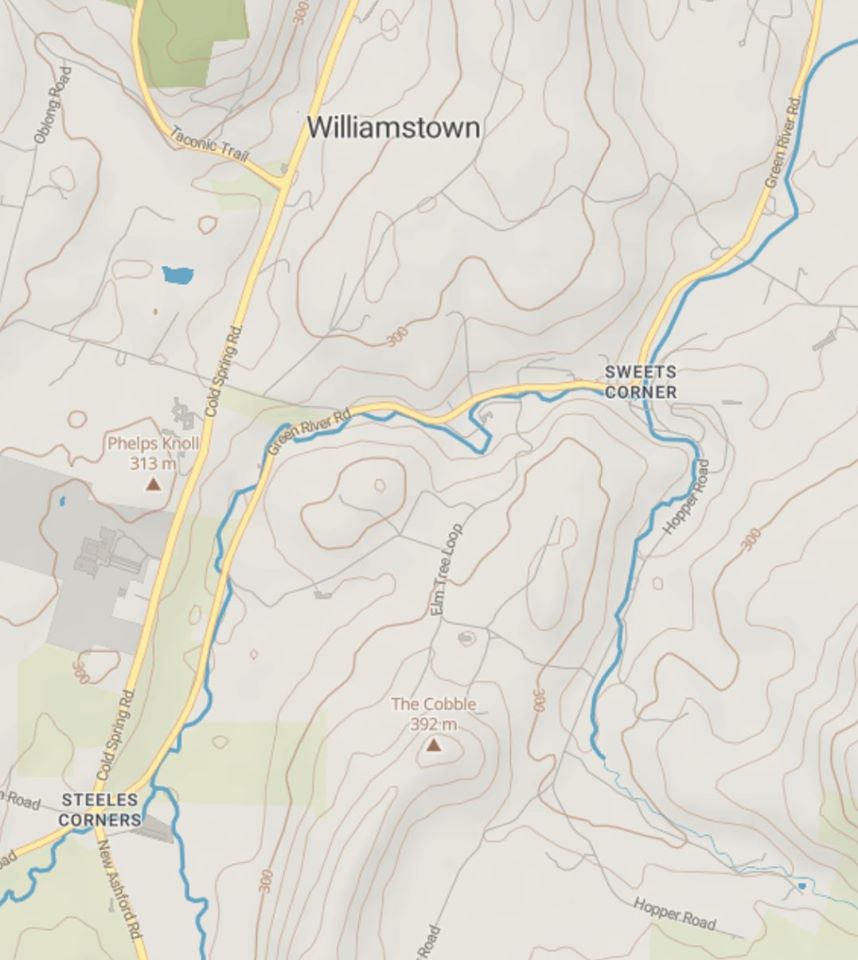
Samuel Taylor was the first owner of lot No. 63 at the junction of Hopper Brook and the Green River, known as “The Crotch” or “Taylor’s Crotch” and now called Sweet’s Corners (see map). Ten acres there were set aside as a “Mill Lot.” After the Taylor family moved away, Asa Douglass of Hancock, the father-in-law of Samuel Sloan, purchased an interest in this lot. On October 15, 1767, the proprietors voted to grant William, John, and Peter Kreiger, a Dutch family who operated Kreiger Rock Mill in Pownal, “liberty to sett up a corn-mill and saw-mill at Taylor’s Crotch” before August 1st of the following year.

Water-powered mills of all varieties were vitally important to the growth of towns in the 18th and 19th centuries. Our most recent WHM newsletter contains a fascinating article on the early mills of Williamstown by Mary Fuqua.  Early Williamstown Mills article.

EBENEZER GRAVES, was born March 15, 1726 in Hatfield, MA. He served at Fort Massachusetts from 1746-1752. Graves was one of the thirteen original settlers of West Hoosuck to build regulation house here between September of 1752 and September of 1753, having drawn lots Nos. 53 & 56. In January, 1753, he married Prudence Hastings of Greenfield, where the couple later settled and where Graves died on October 19, 1814, aged 88 years.

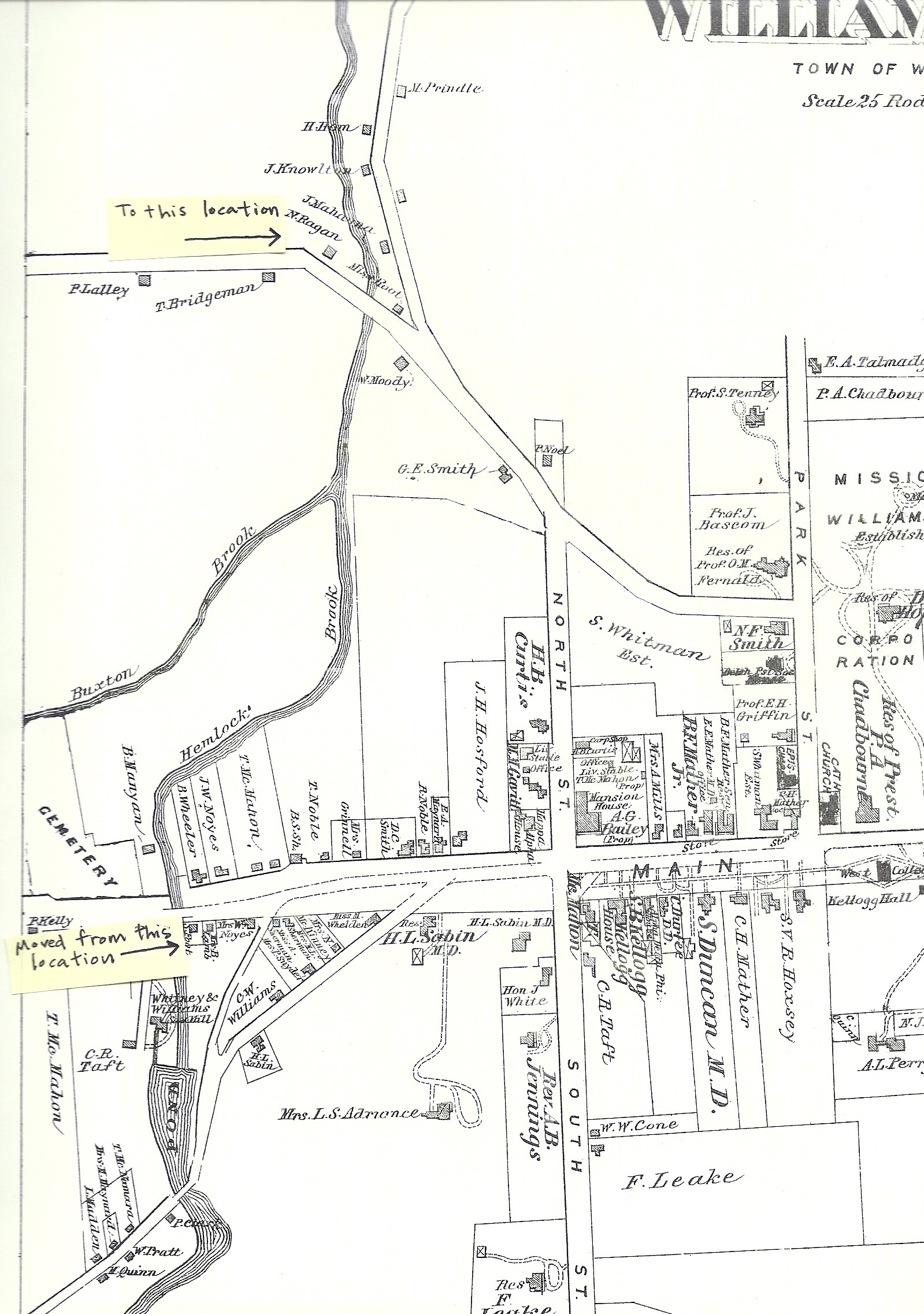
The original house in which the First Proprietors meeting took place was moved to Bulkley Street from the southeast corner of the Hemlock Brook bridge on Main Street via Hemlock Brook.  The current address of the building (or what might remain of it within) is 56 Bulkley Street, and is drastically changed from the original regulation house.


The map below shows the path of the move of the Seth Hudson House down Hemlock Brook to Bulkley Street.

If you can find the site of the First Proprietor’s Meeting, and its marker, we hope you will send a picture to us at info@williamstownhsitoricalmuseum.org.  For extra credit, can you find the “new” location of the house on Bulkley Street?

Discover Historic Williamstown! Week 5

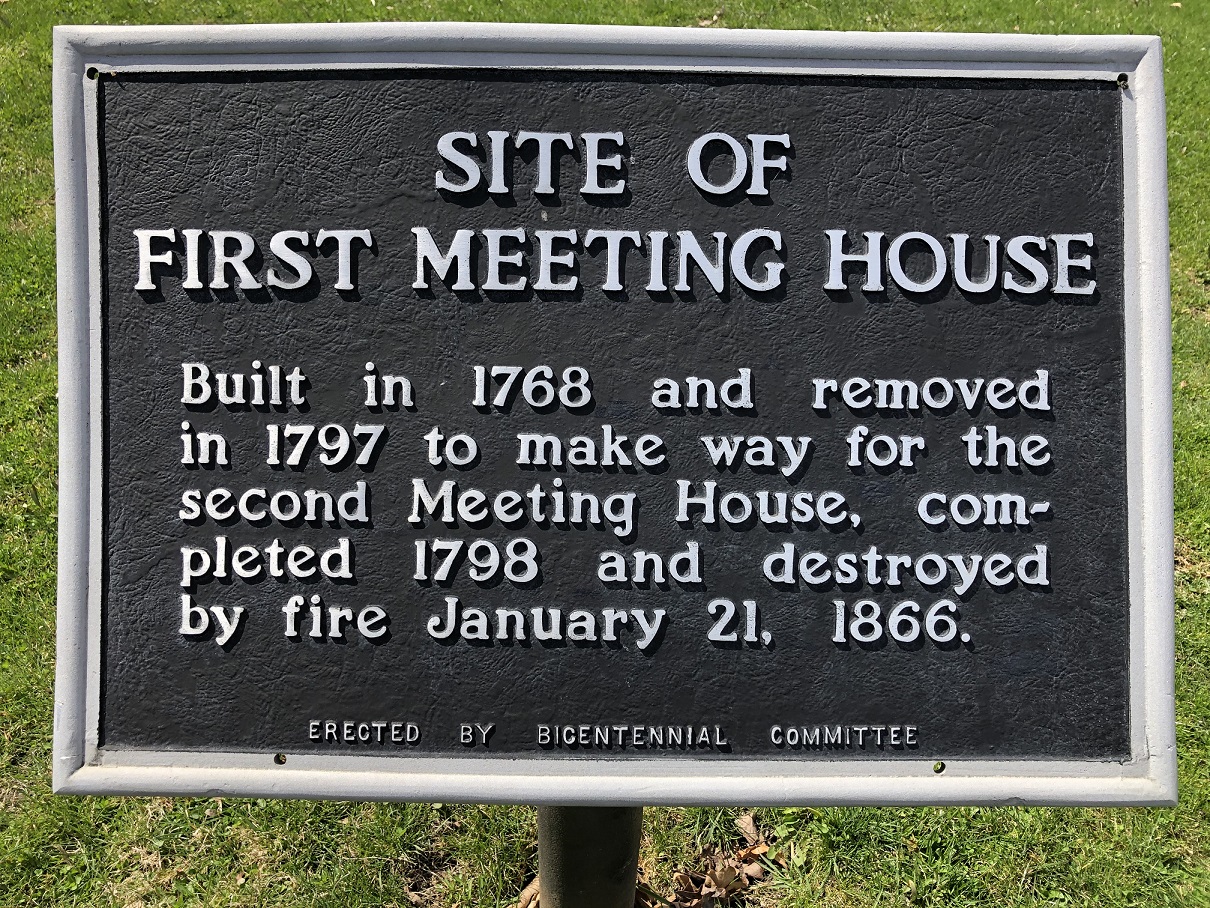
This week’s historical marker is much harder to locate than some of the others. Do you know where the First Meeting House was located in Williamstown and its importance in our town’s history?

There was no separation of church and state in the late 1700s, and the Commonwealth of Massachusetts decided that in order to incorporate as a town a community had to have a meetinghouse and a “learned and settled pastor.” This meant what we now call a Congregational minister. There was no choice, that was the religion of the Commonwealth.

The town needed to incorporate under the name of Williamstown in order to access the money left to them in Ephraim Williams’ will to establish a free school, and they needed a church and pastor in order to incorporate. And yet it took a decade those conditions to be met.

“In 1765 the town was regularly incorporated by the Province authorities at Boston…The proprietors and not the townsmen called and settled the first minister, Rev. Whitman Welch…and paid all the expenses of his ordination; they built and paid for the first framed meetinghouse in 1768…” – Arthur Latham Perry “Williamstown and Williams College” 1899

Moira O’Hara Jones gave a great talk for us in 2015 about the relationship between the town and what is now the First Congregational Church, on the occasion of that institution’s 250th anniversary.

First Church and Williamstown: 250 Years Together Video

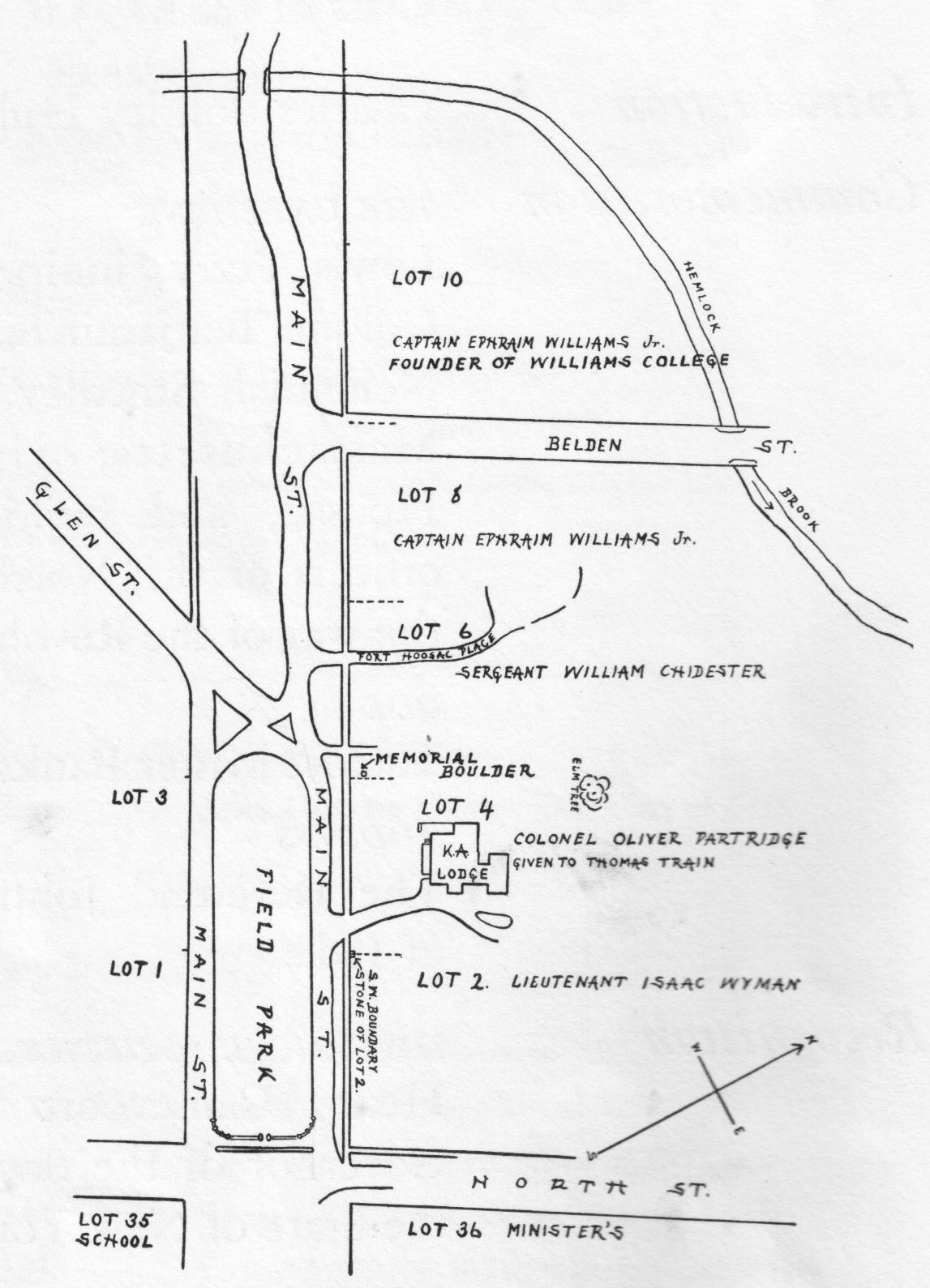
During the years between the settling of West Hoosuck and the construction of the first meeting house which enabled us to incorporate as Williamstown, there was a log cabin referred to as “The Schoolhouse” built around 1763 and located on Lot 36, which can been seen at the bottom right hand corner of this map, where it says “minister’s,” as indeed that lot had been originally reserved for the first minister. (The building would have been about where Mark Hopkins Hall is on the current Greylock Quad.)

Despite its name, it was never used as a school, but as Arthur Latham Perry wrote in “Origins in Williamstown” (1894): “…the proprietors uniformly held their meetings at this schoolhouse for several years; and public worship was held in it, whenever there was any, until the first rude meeting-house was built, 30’ x 40’, in 1768.”

Even after the first meeting house was built, Perry continues: “The log building acquired a certain sort of sanctity thereby, which was never wholly lost as long as it remained standing.”

As was evidenced on the afternoon of August 16, 1777, when the pious women of Williamstown gathered in the Schoolhouse “to pray for the safety and victory of their fathers and brothers and kinsfolk in the battle of Bennington, then raging.”

The Schoolhouse was probably taken down in the mid-19th century when the original “Mansion House” hotel was erected at the front of that building site.

“The proprietors and not the townsmen called and settled the first minister, Rev. Whitman Welch, in 1765, and paid all the expenses of his ordination; they built and paid for the first framed meetinghouse in 1768…” – Arthur Latham Perry “Williamstown and Williams College” 1899

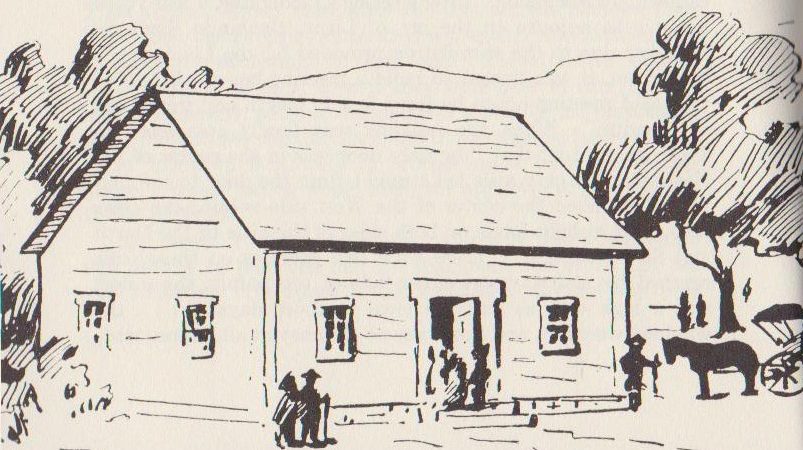
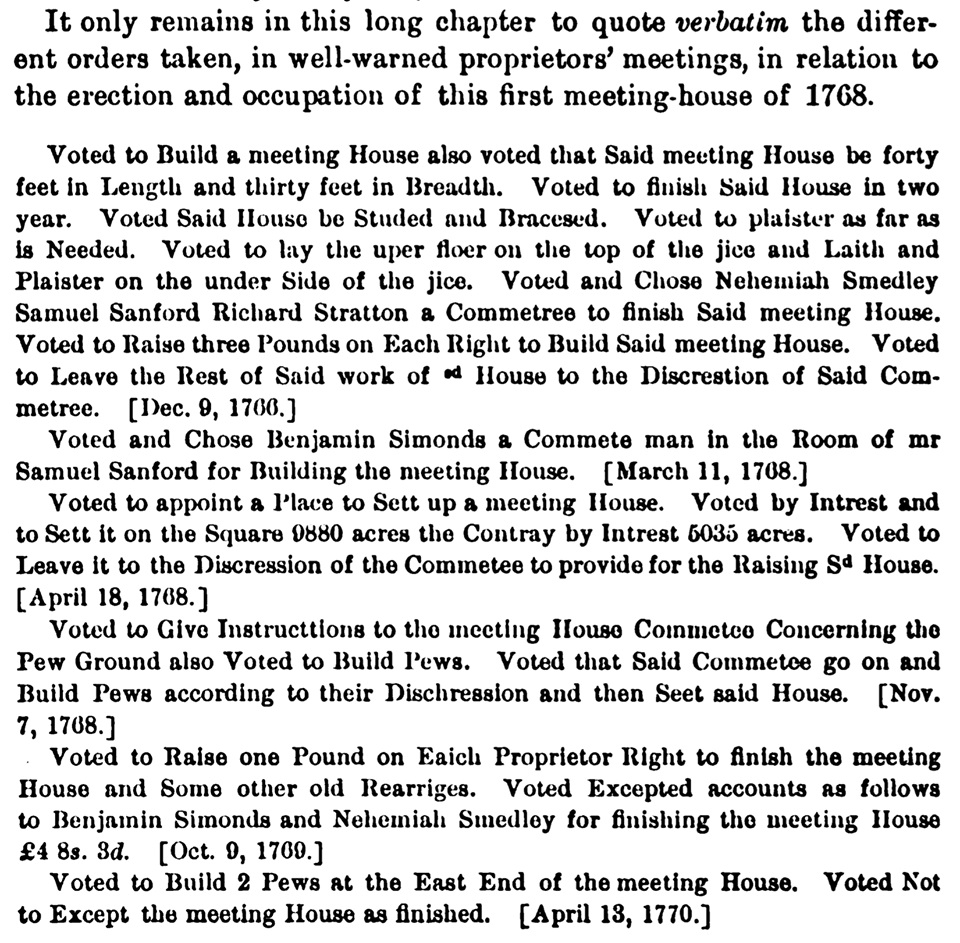
The accompanying excerpt from Perry’s “Origins in Williamstown,” 1894, features snippets from Proprietors’ Meeting minutes c 1766-1770 pertaining to the building of the first meeting house, located in the middle of what is now Field Park. This drawing is the only representation we have of the first meeting house since it was replaced by the second meeting house before the invention of photography.

The first meeting-house was 30′ x 40′. At first it would have had rough bench seating, but then pews, probably box pews, as the First Congregational Church has today, were built and “seated.”

“Colonial churches were generally ‘seated’ each year; that is, each worshipper was assigned a particular seat, determined in accordance with their social or perceived spiritual status in the community.” – John Ogsapian, “Church Music in America, 1620-2000” 2007

There was a “seating committee” for the first meeting house in Williamstown, but not for the second.

While there was talk of “having the gospel preached in this town” as early as the second Proprietors’ Meeting in April 1754, no concrete action was taken until the Proprietors’ Meeting of March 10, 1763, after the French and Indian War had ended, when it was voted “that for the future” they “would have preaching,” and accordingly a call was given to Rev. Moses Warren to preach on probation.

Whitman Welch, the sixth child and youngest son of Thomas and Sarah (Whitman) Welch, was born on June 5 1738 in Milford, CT. He was orphaned by the age of ten when he went to live with an uncle in New Milford, CT, and where in time he was married to Ruth Gaylord.

Welch studied theology, graduated from Yale in 1762 and was licensed to preach by the New Haven Association of Ministers on September 25, 1764.

Immediately after the incorporation of Williamstown, the Proprietors called Welch “to the work of the ministry in this town” on July 26, 1765. He was ordained in October or November of that year, “at which time a church was gathered,” although the first meeting house wasn’t finished until 1768.

While Welch was given the use of Lot 36, the “Minister’s Lot,” on what is now the northeast corner of Main and North Streets (the northern junction of Rts. 2 & 7), he promptly sold it to Josiah Horsford for £25 and bought 18 acres of farmland on the Green River, where he made his home next door to Nehemiah Smedley.

When the Revolutionary War began in 1775, Welch sold his farm to Smedley and joined the militia as a chaplain. He died of small-pox near Quebec on April 8, 1776, at the age of 38. His widow and children had returned to New Milford when he joined the war effort and never returned to Williamstown.

This map shows Williamstown in the upper left hand corner, and New Milford, CT in the lower left, on the Housatonic River just north of Danbury. A number of families followed Whitman Welch north when he was called to preach in Williamstown.

Williamstown struggled to attract a “learned and settled pastor.” According to Arthur Latham Perry: “They had had hard luck and had been at much expense even to get a suitable man to try for a settlement. In two cases where the candidate was willing, the constituency disapproved of him.”

But in neighboring Adams and Cheshire, founded by Quakers and Baptists respectively, they couldn’t incorporate as towns because the Commonwealth of Massachusetts didn’t recognize their worship or clergy as “Christian.”

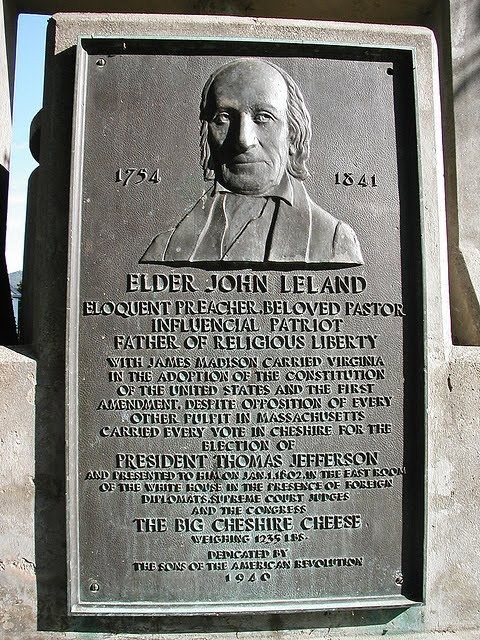
In Cheshire Baptist pastor John Leland worked hard to get Thomas Jefferson elected President in 1800, because he believed Jefferson would work towards a separation of church and state in the newly formed USA, allowing towns like Adams and Cheshire to incorporate without having to abandon their preferred form of worship.

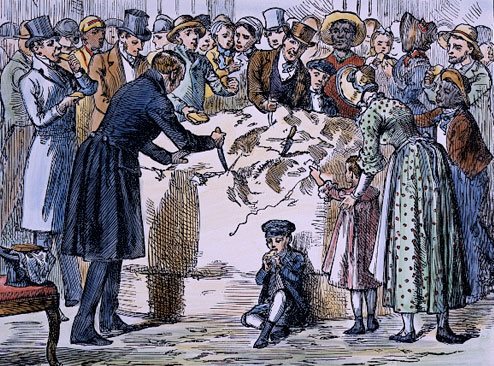
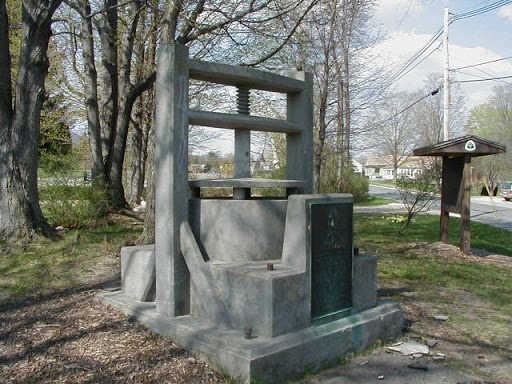
Once Jefferson was in the White House, Leland concocted an audacious PR stunt to call the President’s attention to his cause. He asked all the dairy farmers in Cheshire to donate a quart of milk, retrofitted a big cider press, and created what became known as the Mammoth Cheese.

The cheese weighed 1,235 pounds, was 4 feet wide, and 15 inches thick. Leland accompanied the cheese all along the three-week, 500-mile route. preaching fervently all the way. The cheese bore the Jeffersonian motto “Rebellion to tyrants is obedience to God.”

In keeping with the Quaker’s abolitionist beliefs, Leland informed Jefferson that the Cheese was made “without the assistance of a single slave.”

Leland arrived on January 1, 1802, and presented the cheese to Jefferson, who that very afternoon, penned a letter to the Baptist community in Connecticut in which he coined the phrase “separation of church and state.”

So the people of northern Berkshire County played an important role in freeing both the states and the various faith communities from being under each other’s control.

You can visit the Cheshire Cheese Monument – a replica of the cider press used to create the cheese – across from the Cheshire post office on the northeast corner of Church and School Streets.

Have you spotted the historical marker honoring our first meeting house yet? Both the first and second meeting houses were built on that location, above the initial settlement , on what was then called “The Square,” now the east end of Field Park, formed by the intersection of Main Street with South and North Streets.

The construction of the first meeting house predated the establishment, or even the idea, of a college in town. The future of what we now call the Congregational Church in Williamstown was dictated by the needs of the college, not the congregation.

The first Commencement at Williams College was held on September 2, 1795, in the first meeting-house and “it was felt that the place was unsuitable.” President Fitch immediately began soliciting donors to help erect a temporary gathering place for major college events, but nothing came of that effort.

Before the next Commencement in 1796 there was a stronger and more varied opposition to going into the old meeting-house. Thomas Robbins (1777-1856, Yale & Williams 1796), who was to speak, wrote in his journal : “A scandal to have Commencement in such an old meeting-house.”

According to Arthur Latham Perry: “The College Trustees voted, ‘to hold the next Commencement in the town of Pittsfield or Lanesboro unless a suitable place should be provided in Williamstown,’ and appointed a committee to carry their vote into effect. But nothing was then accomplished, doubtless owing to much ill-feeling then prevalent as between town and college on political and other grounds, and the Commencement of 1797 also was held in the small and dark building.”

But on July 15 of that year Robbins wrote: “Great disturbance in town on account of the meeting-house being set on fire last night: it was happily extinguished: various conjectures about the perpetrators.”

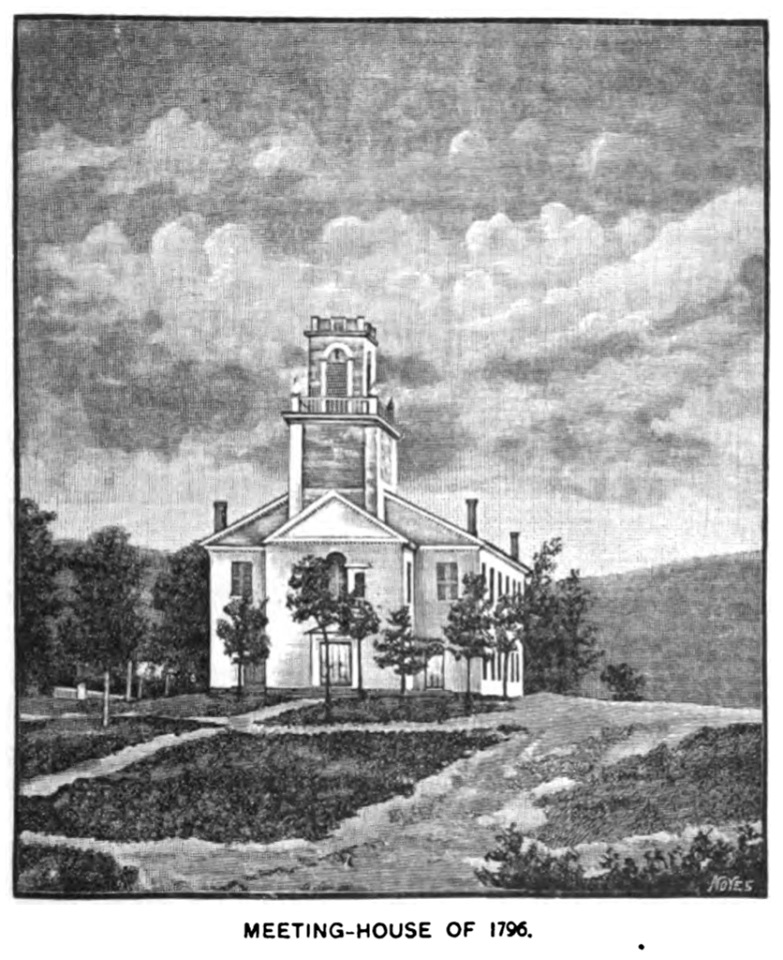
The remains of the first meeting house were “removed a short distance” and used as a schoolhouse, and the second meeting house was erected on the site.

Perry wrote: “[The second meeting house] was so far advanced toward completion at the time of the Commencement of 1798, that its exercises were held within it, and thereafter uniformly until its destruction by fire in 1866.”